
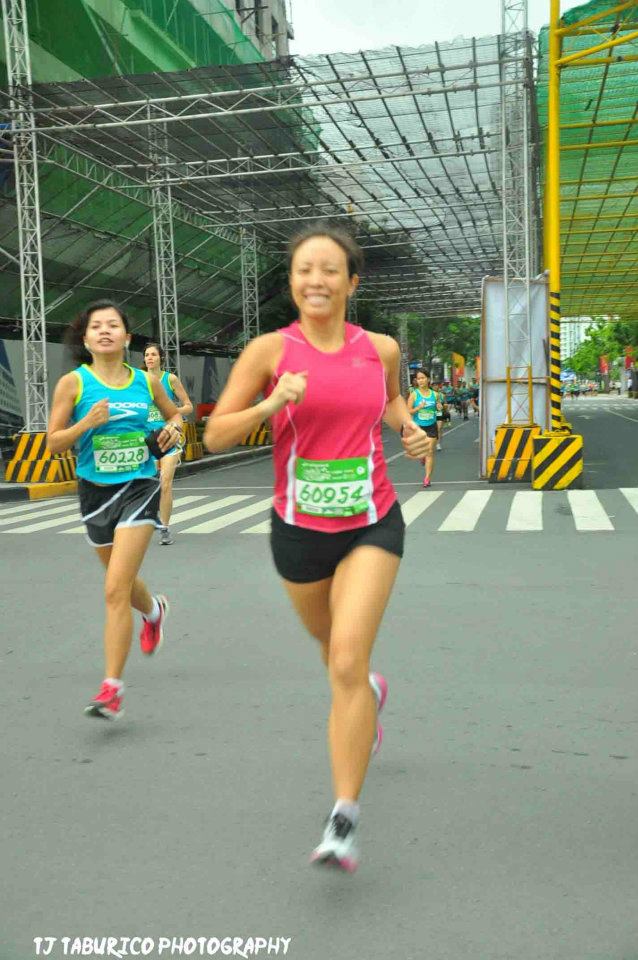
Based on informal chitchat with my fellow runners, I’ve come to realize plenty of people choose to move up to longer distances rather than try to get faster at the shorter distances. But fitness for distance running is made of both speed and endurance, and everyone needs to work on both to improve in this sport.
In my years of running races, I’ve discovered easy ways to boost your speed on race day without (really) trying. I call it “free speed” because you get something for practically nothing. Try them out for yourself. 😉
Find a Pacer
Back in 2009 when I ran 10K at the Philippine International Marathon (a defunct race), I didn’t have a GPS running watch like my Garmin FR 110. However, I knew how to spot runners who have trained to run at a consistent pace. These are usually military-looking men who aren’t breathing heavily. If you can find someone like that who’s going at your pace or just slightly faster, stick close. Pick a spot behind them, or just at their shoulder.
One of three things is going to happen:
- The runner will ignore you, in which case all you will need to do is match their pace.
- The runner will notice you and strike up a conversation after a few kilometers of running. If you’re feeling chatty, this is quite fun and makes the distance go by quickly. By race’s end, you’ll have made a new friend.
- The runner will notice you and feel challenged pick up the pace. If you can keep up, do so! What happens is that you’re “pushing” him or her to go faster. But he or she will be “pulling” you along, which is great at shaving a few minutes off your race time.
I’ve also been blessed to have a few fast-running friends who actively seek me out at races. If it’s one of their “recovery days” they usually “slow down” to pace me. Ate Mherlz Lumagbas who coaches for Milo and for RUNNR Academy did this for me at the Brooks Run, and I was really pushed to run hard because she took the time and effort to encourage me. 😉
Run the Tangents
It pays to look at route maps a few days before a race and maybe recon it if you’re not familiar with the area. You can strategize how to run a winding route most efficiently by running the tangents.
The shortest distance between two points is a straight line, so the shortest distance on a course is the straightest line you can create between the start and the finish while staying within the roads used for the race course. If you follow each street curve staying exactly the same distance away from the side of the road the whole way through, you take more steps compared to shaving close to the curve on a turn. If there are a series of curves on a winding (or S-shaped) road, you should look for the least curving way through.
This is legal because each race course is measured down the middle of its streets; that is its reported distance. It’s also why GPS watch users report a longer race distance in crowded races: they can’t dodge as easily between runners to follow the tangents, and may even have to run on the outside edge of the turns when there are too many people on the road.
Attack the Downhills
I love flyovers because you can freewheel down and make up the extra time you took climbing it. I also use downhills as a recovery period because of the lower effort needed to stay on pace. If you ever come across a route that has successive hills, the speed you pick up going down one hill can help you gain momentum to crest the next hill with less effort.
Some runners I once trained with had been taught the Chi Running method, which emphasizes a forward lean from the ankles. The greater the degree of lean, the more speed one could put on. They’d been advised to lean forward and attack, even on downhills.
Of course, this particular strategy is conditional on the degree of the incline. I ran hills in Pico de Loro during the Next Step Tri Camps, and we asked Coach Ani de Leon-Brown, an elite Ironman athlete, how she would handle downhills. She said if it were a gentle downhill, she would accelerate going down it. However, if it were a steep hill, she would save her knees and just go down at a controlled trot, or even walk it.
If you do end up trying one or more of these strategies, please come back here and tell me: do these get-fast-quick schemes also work for you? Or did you use them before, and how did that work out for you?

Thanks for these great pieces of advice. Time to try and get back into shape and use these for “free” speed. More power to your site.
You’re welcome! Let me know if they work for you.
Thanks for the tip. Can’t wait to try some of these 😀
Let me know if it works, RunReal. 🙂
i requested my elite teammate to pace me yesterday because i want to achieve a sub-2 half marathon. all throughout the race, he was just slightly ahead of me and running at a consistent pace, and i was like locking up on him so that he will never leave me far behind. the result was 1:58:28!
Congrats Dennis! I also saw your blog: congrats on your Warrior ultramarathon finish!
“These are usually military-looking men who aren’t breathing heavily.”
Haha. You just described me to a t. =)
I once TRIED to run behind the kikay runner. All was well but after a quick drink, I looked up and you were already gone! hehe!
This was during this year’s Milo marathon. My goal was to run a sub 50 10k (my first) but I fell short by about a minute (1 minute and 23 seconds to be exact). Anyway, the only time I saw you again was when I crossed the finish line. We had a quick chat and you told me to try to run the tangents next time. Two weeks later at the Regent Fun Run, I did exactly that and I clocked in at 49 minutes and 24 seconds (my current PR). EPEKTIB! :))
Thanks Noelle!!!!
Congrats on your new PR Benedict 😉
Thanks for these tips. I usually do number 1 and 3 but number 2 I have to try next time. When I run with my buddies, I usually tell them to try chasing someone in front of us. After catching up and if they can still go further, we overtake and go after another runner in front. If not, we just stick with the pace. Just sharing… =)
Hi Kikay, may nabasa ako na part of training e yung sprinting para makakapagpabilis ng pace.. Mga ilang beses ko ba sya gawin for example 3 times/per week ang time ko sa pagtakbo. Before nag long run half marathon time ko around 2:10 pero ngayon mas prefer ko na short distance races 5k-10k. I can do sub 1 pero gusto ko sana maka sub 50 or sub piolo sa 10k.
If you’re running 3 times a week, use one session for speedwork, one session for a tempo run (the target distance but at slightly slower than target race pace), and one session for a long run for endurance.
I’m a newbie in running and I just started a week ago. I stumbled across your blog and I’m so happy. I’m gaining a lot of insights and techniques from you. Thank you so much! Keep on running, keep on blogging! And keep on inspiring. =)
Thanks Gen! That’s really why I have this blog in the first place — to share whatever I’ve learned and hopefully to get people to come with me on this fitness and wellness journey. 🙂
I like this post! 🙂
u missed drafting, It work well if very windy. And also lifting your foot as u push/propel forward
i’m doing run the tangents…
Thanks Ms. Noelle… I usually do 2; 1; 3…. mostly run the tangents… eka nga ni Phytagoras mas malapit pag ganun…
I did the pacer bit last night but had to fall back just to abdominal pain lol.
How was your warm-up? I find that if I go out too fast at the start, I get those cramps too.
ganda nang stride!
Great tips Noelle! First time I encountered running the tangents. Oo nga ‘no, that’s a good strategy. 🙂
Regular lunges and stretches. Combined the ones posted in your blog and a couple more from a diff website. I read somewhere that solid/liquid intake prior to a run is sure to give you cramps.
Of course a full stomach would put stress on the abdominal muscles. But small amounts of food (30 mins before) and liquid should be fine.
This is a problem for me. Last night, I only finished half my goal because of the cramps 🙁 I will run tonight pero will not ingest anything before running. 🙂
Another great article!
u look like speedy gonzalez he he